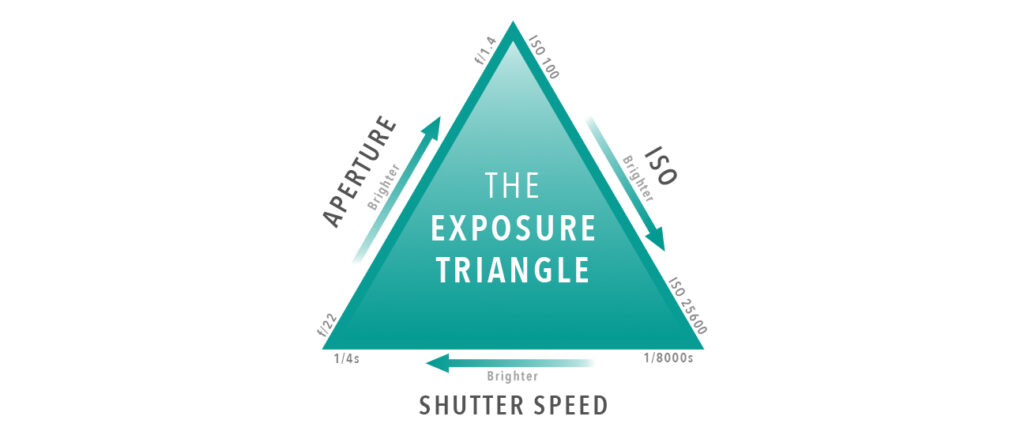
The exposure triangle is a fundamental concept in photography that explains how three key settings—aperture, shutter speed, and ISO—interact to determine the exposure of an image. These elements control the amount of light reaching the camera sensor, influencing the brightness, depth of field, and motion in a photograph.
Components of the Exposure Triangle:
Aperture (f/stop)
• Refers to the size of the lens opening.
• Larger apertures (e.g., f/1.8) let in more light, creating a brighter image and shallower depth of field (blurry background).
• Smaller apertures (e.g., f/16) let in less light, creating a darker image and greater depth of field (everything in focus).
Shutter Speed
• Determines how long the camera’s sensor is exposed to light.
• Faster speeds (e.g., 1/1000s) freeze motion but allow less light.
• Slower speeds (e.g., 1/4s) capture motion blur and let in more light.
ISO
• Indicates the camera sensor’s sensitivity to light.
• Low ISO (e.g., ISO 100) is less sensitive, producing cleaner images in bright conditions.
• High ISO (e.g., ISO 6400) is more sensitive, useful in low light but introduces noise.
To Achieve a properly exposed image, adjustments in one component require compensatory changes in the others. For example:
• If you open the aperture wider (f/2.8), you might need to increase the shutter speed or lower the ISO to avoid overexposure.
• If you increase ISO, you can use a faster shutter speed or smaller aperture in low-light conditions.

Here is a diagram illustrating the exposure triangle in photography. It shows how aperture, shutter speed, and ISO interact to control exposure, depth of field, motion, and noise in an image. Let me know if you have further questions!

Author: Peak District Focus
Peak District Focus Webmaster


You must be logged in to post a comment.